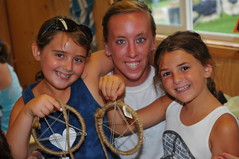
Before setting off for camp, some campers and their parents wonder about how they will fit in, since it’s natural to try and imagine new experiences ahead of time. However, like most adventures, camp often turns out to be wonderful in ways that can’t be completely anticipated! If you’re still wondering about going to camp, you’ll be interested to hear about the experience of India (9) and Athéna (6), who crossed the Atlantic from France to attend Camp Weequahic last summer. Well, at first the plan was for India to go to camp, but after watching the Camp Weequahic video and getting goosebumps 10 to 20 times, Athéna became determined to go with her sister. Their parents did a lot of research and supported the girls going to camp 100% — a combination that led to a fantastic summer camp experience for the whole family!
The girls’ mother Shaila-Ann, looked for a camp to meet her specific criteria—a camp that was not too big, near a major airport, co-ed, and with tons of new activities for her child to experience. Shaila-Ann also feels it was important to choose the camp before presenting it to the children (especially for those as young as hers), so they felt secure with a decision made by their parents and didn’t feel pressured by such a big question. She also reports that looking back, using online resources like the video “really gave a feel for the actual camp experience,” and allowed India and Athéna to participate in the process.
The family met camp directors Cole and Kate at an information meeting. They immediately felt that Cole’s criteria for choosing staff was in line with their values and could see that he was fully dedicated to camp and facilitating a caring family environment. These parents especially felt that nobody could “pull the wool over Cole’s eyes” and this gave them “tremendous confidence in taking the leap of faith to send the children to a place [they] had not visited themselves.” Once at camp, the girls felt included and supported by camp staff and other campers, which is what their parents had predicted! The girls were happy and their parents enjoyed that reassurance with so many miles between them.
India and Athéna really loved camp and also gained a first hand experience of diverse American culture—exactly what the family was looking for. India was thrilled that she could communicate with Spanish speaking campers from Florida although at first she imagined they were from a different country and not part of the United States. Camp really broadened her concept of the States and understanding of North American families and geography! Athéna learned that she can make friends and have a wonderful time without being completely fluent in English—now both girls use those skills in meeting people and exploring their world. Their parents still make sure to share how proud they are of their girls who fiercely embarked on their camp adventure and had such a memorable time. They haven’t pushed for details about everything and Shaila-Ann says, “even today several months later the girls will suddenly relate their success in overcoming their initial fear of going down the zip line or a funny incident with one of the wonderful counselors that made them laugh. . .”
Shaila-Ann is thrilled that, “the Camp experience enabled my girls to feel that they can do pretty much ANYTHING–since they felt accepted and “at home”–at camp in a foreign country they had never visited!” Learning they can feel secure and happy on their own anywhere built tremendous confidence and India is thinking of studying in the US when she is older. “For my younger daughter who was not so fluent in English, the experience showed her the benefits of speaking up in order to interact with others and that skill will last a lifetime!”
Camp Weequahic is committed to caring for individual campers and creating an environment where campers grow and friendships blossom. Camp staff are trained and dedicated to helping campers feel included and encourage campers to care for each other. This reciprocity of sharing/caring is core to the whole inclusive experience and foundational to developing capable children–even as young as India and Athéna. Now that’s kid power!
Do you have a similar story to share? How has summer camp shaped independence in you or someone you know?
Thanks Shaila-Ann, India and Athéna for sharing your adventure–and well done girls!
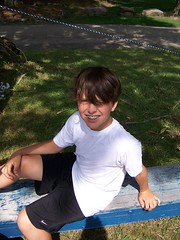
In an earlier blog we wrote about how to judge whether or not your child is ready to go to camp and pointed out that it really depends on your unique child and their level of maturity. One mother, Christine, puts it this way, “each kid is different…each mum is different …so I do not feel I can really give blanket advice. . .” However, Christine’s 12 year-old son was ready to go to camp—so ready that last summer he came to Camp Weequahic from Switzerland and arrived without knowing a single other camper!
Nicolas had mostly attended an international school and studied English in Switzerland, so his communication skills were well developed and he felt comfortable with the prospect of adjusting to a new culture. He had also previously visited the United States and after switching to Swiss school last year, his mother wanted him to retain his fluency in English, learn about American culture first hand, and make American friends. Christine says there are a number of American camps that promote their programs in Switzerland but she avoided their outreach since she “did not want to send Nicolas to the United States just to meet other French guys!!!”
Christine decided instead to look for a “really American camp” on the internet and spent a lot of time researching and comparing her options. What guided her final choice was the Camp Weequahic website with its video clips, and she was drawn to the camp’s obviously family atmosphere. After all, she was sending him a long way to try different things and have new experiences! Since Nicolas travelled from Europe, a three-week session seemed the perfect fit—two weeks seemed too short and four weeks seemed too long for a first time camp experience across the Atlantic.
Nicolas travelled to camp with his mother and then later flew back to Europe by himself after the Weequahic staff put him right on the plane at Newark Airport. (It’s also worth mentioning that each airline has its own rules about when and how children can fly alone.)
Christine’s nieces both had a wonderful camp experience in the United States, but Christine felt that Nicolas would be more open to forging friendships and getting to know American kids, if he ventured on his own—and every mother understands that each child is different! Nicolas completely agreed about coming to camp on his own and since he was a little familiar with American culture and speaks English, that’s what worked for him.
In Geneva, Nicolas has developed friendships with students from all over the world and his mother’s commitment to raising a globally-aware child was well under way, but coming to the United States added a whole new level of intercultural awareness. For example, camp gave Nicolas time to develop deeper relationships with Americans his own age and broaden his knowledge about the game and traditions of baseball. He also experienced cultural details that a tourist might miss. Nicolas loved Camp Weequahic so much that he wants to return and is now dreaming of coming back as a CIT (Counselor in Training). His younger brother has also caught camp fever and wants his turn as a camper too!
No matter how many miles a camper literally travels to camp, the adventure stretches them in many ways and contributes to measurable personal development. Campers return changed from both travel and their personal journey–and in Nicolas’ case, even more fluent in American English! Have you sent your child on a long distance to camp? How did the experience help your child develop self-reliance and skills? How did you decide what your child could handle?
Thank you so much for sharing your story, Christine and Nicolas!
As parents, we often hear predictions about the necessity for our children to prepare for a new and “global” world. While some people explain that the roots for global interactions were planted centuries ago, current electronic and transportation technologies make people across the globe even more connected and interdependent. So how can we prepare our children and give them experiences to help them become globally literate?
Of course, travel is an obvious way to help children increase their cultural currency, but going to camp also helps foster global thinking and skills in specific ways. Summer camp is a place where children from around the world and different parts of the United States connect with each other, build lifelong friendships, try new things and practice living together. At Camp Weequahic for example, campers have recently travelled from France, Spain, Switzerland and Venezuela to join in the fun. On average, about 5% of campers come from outside the United States but wherever your child departs from, they can benefit from the diverse mix of kids at camp. They can practice a language and will definitely learn about different customs with daily interaction and time to soak it all in. Most importantly, they will learn how to respectfully engage with people with different views, who may not approach everything the same way.
In her book, Growing Up Global:Raising Children to Be At Home in the World, Homa Sabet Tavangar says that the first step towards developing a global outlook requires “embracing the mind-set to make a friend and be a good friend.” Making friends means practicing universal qualities like empathy and respect, and building lasting friendships at camp is a huge part of the total experience. Counselors and staff are trained and at the ready to help campers grow in this area, build new skills when necessary and model caring for others. Tavangar explains that versions of the Golden Rule, or “treat others as you wish to be treated,” permeate all cultures and faith traditions and elaborates on these in her book. When children embrace the universal values of caring for each other, they employ humility, curiosity and compassion which then leads to making true friends—and that’s what makes a world citizen.
So, wherever we go in the world, it’s the experience of breaking down the elements of diverse cultures and seeing what makes them similar or distinct, that prepares us for relating to each other. For kids, a baby step towards negotiating new cultures can be overcoming the fear of new foods or being away from home at camp where things are “different”—after all, every camp, and each year, has it’s own special character or culture. For example, many campers bond over the issue of learning to like new foods and it’s that kind of experience that prepares children for the future.
Growing up global is not just about preparing to do business in the world economy. It’s about having the comfort and desire to connect with the Kenyan dad who coaches a local soccer team, a Turkish neighbor with distinct fashion style or an American who expects consistent electrical power! Ultimately it’s about being curious about differences instead of afraid of them and valuing making friends with the diverse people we meet. Psychologists link friendship to an individual’s health and ultimately to the ability to survive—so friendships are key to feeling at home in our individual skins as well as feeling at home on our planet.
Our experiences at summer camp are a key component in raising globally aware and confident children. The friendships and lessons learned at camp will last long after camping season ends as campers continue to expand their horizons, stay connected with friends across time and geography and find their life’s passions. How do you plan to raise global kids and make camp a part of their preparation? Have you read Growing Up Global or used any of Tavangar’s suggestions? We’d love to hear how camp contributed to defining your world view!