Tag: Courage

Lessons from Claire

Parents, the words below are my lessons from a camper who has recently passed. I wrote it in a way that I hope will be helpful and thoughtful of our camp family. Please review it before deciding to share with your child. This one may be more for me than anyone else.

Kate and I ‘received the torch’ from the Seffer and Lustig families in 2009. They had built Weequahic from the ground up starting in 1953.

We dug in and started building on the wonderful foundation and traditions (Tribals, Olympics and more) the Seffer and Lustig families created while instituting some of our own (Campfire by Sly Lake, GAC, Swim the Lake and more.)

No matter what, though, no matter who is running camp or how long the sessions or what names of the color war teams are – it’s all about the kids and staff.

The people are what make camp – then, now and forever.

Claire

I first met Claire in her home outside of Philadelphia. Then, as now, we met with every family prior to camp. I remember her being quiet and interested with a twinkle in her eye.

When she told me soccer was one of her favorites, she leaned in and her face got serious and excited. I could tell this young lady was a competitor. Creating a life with Director Kate and spending so much time with Associate Director Sue, I know the type well.

Claire started with three weeks – the Tribal session. After two summers, she was one of the first to switch to ‘Olympic’ session. A few of her friends had moved to Super Six and she had another commitment early in the summer.

This was the first of the lessons from Claire – the courage to be flexible. We had always hoped a camper would change things around in order to make both their busy summer lives and camp work… but we didn’t think it would happen. And for a 14-year-old girl to do it?

Claire knew what she wanted and she just did it.

Saying No

The second lesson happened either that or the next summer. I’m hazy on the timing but not on the lesson.

True to form, this young lady was a fierce competitor at Weequahic. Always first to join a team, compete with other camps or within Weequahic. She wanted to move, to exert herself all the time.

Prior to arriving back at camp late in her time with us, her mother called to talk about her concussions. Claire had dealt with a lot of them. Her mother was (rightfully) concerned and wanted to know how they’d affect her at camp, especially with her athletics.

Now, we were always scratching and clawing to grow camp. At the time, I was definitely a ‘yes’ person, at least to the parents and the kids.

I didn’t want to say ‘no’ to anyone and I didn’t want to upset anyone at any time. So, we accepted her back within some strict guidelines. Claire was on board… kind of.

That summer, I had to say ‘no’ to a lot of her questions. When she came up teary to me, pleading to play and compete, I had to say ‘no’ for her safety. When she enlisted her counselors – who loved the girl – I had to say the same thing.

It’s hard to see anyone who wants to compete and play so badly and tell them ‘no.’ Especially when you want them back as a CIT. But ‘no’ it was, and it was the correct call.

Sometimes (a lot of times, actually) ‘no’ is hard… and correct.

Friendships Across the Bunks

I’ll be honest – I was pretty old-school when we started at Weequahic. When girls used to tell me some of their best friends are boys or guys tell me, ‘We are just friends’, I didn’t really believe them. I’ve read enough about evolutionary biology to be dangerous… and a little cynical of those answers.

Claire taught me differently, especially with her friendship with Budow. They were tight. They were buddies. They loved each other in a way that true friends do, with trust, care and vulnerability.

Their special friendship opened my eyes to see so many others of these friendships at camp between our campers. Funnily enough, when I asked a CIT last summer about what camp had taught them, she answered ‘Guys and girls can really be just friends. I love that about this place.

Me, too. We humans need connection and care. Claire and Budow represented the best of this.

Final Lesson

When Claire graduated as a CIT, cried her last tears in the Rec Hall and departed camp, I lost touch with her. A wonderful camper, someone who stood out amongst the pack, and… well, I turned my focus to the campers in front of me rather than those in my past.

This was and is a mistake. And one I intend to rectify.

Had we stayed in touch, I would have known about her matriculation to a great university. I would have known about her work within healthcare, her continued connection with Budow, how her faith and connection to Judaism continued to flourish. That she had been sick and that the complications were growing.

Time is doing what it does… moving forward. We will all have hard moments like these in a well-lived life. Sad? At times, of course. And full of beauty and laughter, lessons and love. If we only see the bad or challenging, we aren’t really looking.

We are going to miss Claire. She was a bright light in the world and one who taught me many things. Thank you, Claire. We are better for having known you.

We Should vs. I Will

One of the most incredible discoveries of the 20th century concerned the structure of light. That which comes from the sun (and the tiny light above my seat on the plane as I type this) is both a wave and a collection of tiny packets of energy. Imagine millions of little ping pong balls of energy moving together to form a wave. Pretty awesome. (I like to think of it as the turtles jet stream-scene from Finding Nemo.)

This discovery helped to explain a lot of physics that I don’t understand… though I’m very happy it happened. Regardless of the science, for the purposes of this little campfire lesson, it’s how light is constructed – millions of packets of energy acting, moving and dancing together – that’s important.

We Should vs. I Will

We live in a great country. Do we have problems? Of course. In fact, if you read the news, you’d think things have never been worse. However, if you are a reader of history or a person that looks behind the sensational to look at the actual data… well, a very good argument could be made that things have never been better.

We live in a country where people lend a helping hand their neighbor. How do I know? Because one of our boys lives in Boone, NC where a once-in-a-100-year-storm left enormous devastation. Many people who live outside the town are now weeks without power and drink and eat only from the gifts and service of others.

There were a lot of people saying ‘we should’ do something… and then not doing anything. However, the gifts and service that is happening came from a collection of individuals (or ‘I’s’) doing something about the problem. The ‘we shoulds’ around the country did nothing but lend an opinion. Those who spent their time and their resources to aid these people are those who said ‘I will.’

When the collection of ‘I wills’ became strong enough, they became a wave that stared to bring the light of community and warmth of support to the people of Boone and Ashville and Blowing Rock and so many other places. This is true in almost every other ‘help needed’ situation out there… including camp.

‘We should’ is an opinion, a small set of words in the wind. They mean nothing.

“We should be welcoming to a new camper in our bunk.” Absolutely. Now – HOW do you do it and, looking back, DID you?

“We should confront a friend who is being mean.” Totally. Did you?

“We should be kind to one another, even when we disagree on something like food, religion, video games, or who our parents vote for.” Absolutely. Did you act so?

It Takes Courage

‘We should’ works only when it’s followed by at least one ‘I will.’ One person stepping forward with the courage and humility to act can and will draw others. Courage, just like fear, is contagious. 

Maya Angelou once said:

Courage is the most important of all the virtues because, without courage, you can’t practice any other virtue consistently.

Of, as Winston Churchill stated:

“Courage is rightly considered the foremost of the virtues, for upon it, all others depend”

It’s the exercise of courage that turns ‘we should’ into a whole bunch of ‘I wills.’ Doesn’t mean you are always right (or wrong). But at least you’ll be doing something that can be reviewed and changed, if needed.

So… go be an ‘I will’ rather an a ‘we should.’ As President Adams enocouraged his children: Be good and do good.

Courage and Freedom

One of the ladies I enjoy learning from gave a big speech the other day. The whole thing is worthwhile but I wanted to focus on a story she relayed near the end: 

…when, on a trip to Israel, I met my hero and now my friend, Natan Sharansky, I really only had one question for him. I asked him if it was possible to teach courage. 

He paused and said this: “No. You can’t teach it. You can only show people how good it feels to be free.

Bari Weiss, 92nd Street Y Address

By now, if you’ve been a part of Weequahic or read anything we’ve written, you’ve come across our feeling about ‘courage.’ I’ve written about it a few times. 

As a person who beats the drum about ‘courage,’ I was stopped by Mr. Sharansky’s reply. And, I think he may be right. 

Definition

So, before we start, how do we define courage? The Oxford Dictionary defines courage as the ability to do something that frightens one.  So, in other words, you’ve got to be afraid in order to be courageous. 

It doesn’t matter if you are feeling fear from looking down from the zipline station or getting on the bus for the first time, getting up on stage to address the whole camp or connect with your new bunkmate soon-to-be friends. Feeling no fear? No courage is needed. 

And, without courage, there is no freedom – from fear or anything else. Campers, this is important:

Just because you ‘feel’ fear doesn’t mean you are ‘captured’ by it. You still have the freedom to act as you’d like. It’s simply up to you.

Viewing Courage

When I think of teaching, I mostly think of book-learning and Mrs. Vipperman introducing biology to me as a seventh grader, chalk in hand and frog in front of me. (She was a heck of a teacher – and very memorable.) And, I’ve learned (a bit) about courage and the freedom it creates from books.

I’ve read a lot about people who have shown courage. Whether it be about Dr. King or George Washington or Mahatma Ghandi or Mother Teresa or Harry Potter or John Snow, I’ve got stories and stories and stories in my head of people who lived ‘free.’ 

From these stories, we can be introduced to courage and living free. It’s better, though, to be surrounded by people from whose example you can learn in real time. 

‘Doing’ Courage

The second best way to learn how to live free is to watch those around you. At camp, counselors come to mind first. They’ve chosen to become part of something larger than themselves and pour everything they have into making the summer amazing. It takes courage on their part to do so. Why? Because it would be so much easier staying home and working at the GAP or the coffee shop or doing an internship in some big office. But… those things are rarely as meaningful, purpose-full or fun.

The next group I think about as ‘examples’ are our CITs. Watching them balance their responsibilities of leading camp with the fantastic benefits of being a CIT (fridge in your bunk, more flexible time, their own Cove space, etc.) is very instructive. 

The very best way, though, to learn anything (just about) is to do it. Badly, at first, most likely. When you learned to walk, it was a stumbling, bumbling, hair raising experience for both you and your parents (for different reasons.) But you learned. 

Courage is the same way. Start off by standing up against something small that frightens you. For example….

I remember young Luke being afraid of snakes at first. With the help of a fantastic naturalist and surrounded by his parents, Luke (barely) touched a small black snake.  A little later that day, he held it with the naturalist’s hands underneath his own. After learning more and taking instruction seriously, a few days later Luke handled the snake on his own. Ultimately, he wound up showing other kids the snakes and helping them through their own fear.

Requirements

What does it take to build courage? A couple of things: 

1.     Opportunity – you can’t start practicing if you don’t have the opportunity. Camp, as you may have already guessed, is a great opportunity. So is the classroom! 

2.     Encouragement – Get around people who you KNOW want the best for you and let their support put wind in your sails. Your parents, coaches, teachers, siblings (yes, I said it) and close friends. And DEFINITELY your camp people.

3.     Curiosity – You’ll never know what is on the other side of that fear you are feeling until you experience it. If your curiosity edges out your fear, you’ll be ready to show the courage to try. 

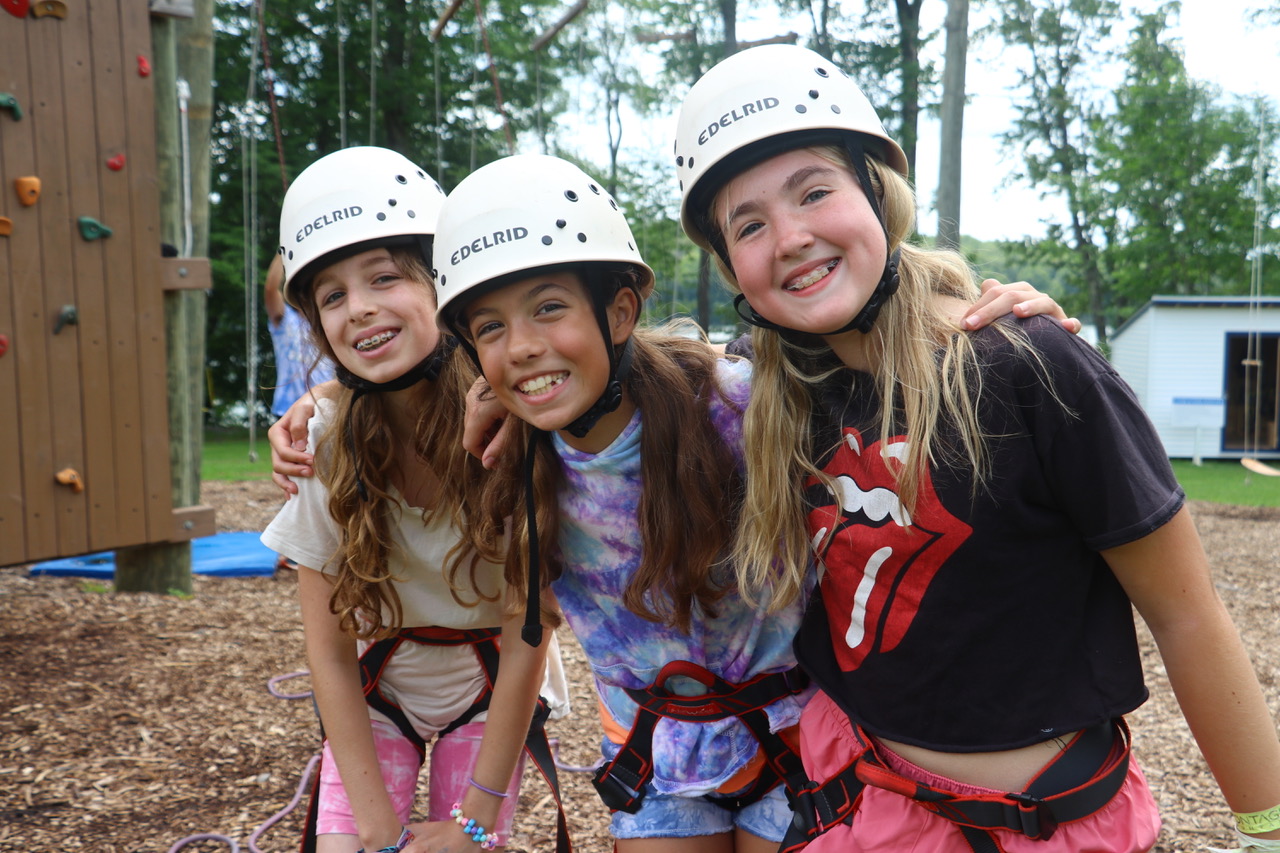
4.     Safety Net – Hey, Miguel would never let you on the trapeze without the net, your safety harness and several good pairs of hands to support you. Kiera and Osmar wouldn’t let you climb without your harness, a properly tied rope, helmet and spotter. Make sure you’ve got your safety net around you… and then jump!

Courage will open up the world to you. You’ll be able to enjoy more thoughtful relationships, experience deeper satisfaction and extend past your self-perceived limits. There will certainly be bumps in the road and…, well, so much more joy, too. 

Go on, camper. Take the first step to get past that fear and feel the joy of being free. We’ll be here to help.